Wednesday, April 22, 2009

Beyond Human Frequency - Snapple "Real Fact" #48

Did You Know?


Fact: Cats can hear ultrasound.


Ultrasound is the frequency of sound waves greater than what the human ear can hear (approximately 20kHz). Cats have an approximate hearing range of 45Hz - 64,000Hz compared to 65Hz - 20,000Hz of a human hearing range.

*Infrasound is any frequency below the average human hearing range.

Wednesday, April 15, 2009

The Straight Dope and Real Facts

I've been drinking Snapple recently and i've kept the caps containing "Real Facts". Every cap has a different fact and SO, i'm going to keep track of what i have collected here and perhaps do some extra read up regarding the facts.

As i was surfing the web, i came across this website The Straight Dope.com. It's a website (by a person called Cecil Adams) that contains MANY questions and answers and some other random bits of information that may intrigue you. Claiming to be the smartest human on Earth, why not go check out what he has to offer you?

Pink Flamingos - Snapple "Real Fact" #11

Did You Know?

Fact: Flamingos turn pink from eating shrimps.


Shrimps contain red pigments classified as carotenoids which is found in carrots too! A lack of carotenoids in the diet of a zoo-kept flamingo may turn a flamingo white.

Wednesday, April 1, 2009

Esters

Question: Work out the number of esters with the molecular formula C4H8O2. - passerby


My reply: Esters have the functional group R-O-CO-R'. My drawing out the compound and permutating the number of ways the functional group can fit into the compound, this is what I get.
By inserting the functional group between the 3rd and 4th carbon atom will yield the same structural formula as (1). Hence, there're only 2 different esters resulting from the C4H8O2 formula. ;)

Monday, March 23, 2009

Bromoethene vs Bromopropene

Question: Suggest an explanation for e unreactivity of Br in bromoethene as compared to 3-bromo-propene - passerby


My reply: Okay, firstly i would assume that you're asking about electrophilic addition for both reactions involving Bromine. Bromine as you know is an electrophile, which is also an electron withdrawing atom. Hence, Br in bromoethene will "spread" the electrons out from the electron rich C=C and stabilises bromoethene. In 3-bromopropene (i'm assuming it's 3-bromo-prop-1-ene), the Br atom is too far away from C=C and hence it does not really "spread" the electrons from the pi bond across the molecule. In this way, the C=C pi bond in 3-bromopropene will be more susceptible to a bromine attack compared to bromoethene.

Monday, March 9, 2009

Iodoform test

The iodoform test (or tri Iodomethane test) is used to identify the presence of 2 particular structural units:


1)RCH(OH)CH3

2)RCOCH3

*R denotes H, alkyl or aryl group


In positive tests, the reaction will produce a yellow precipitate of CHI3.
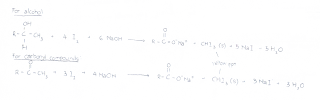

*Click on picture for a clearer and bigger view


Any compound which contains the above mentioned structural units will result in a positive iodoform test. Ethanol is the only first degree alcohol to give a positive iodoform test. The following are some alcohols which may produce reactions with tri-iodomethane.

The compounds which produced a positive reaction all have the specific functional group [RCH(OH)CH3] and the boxed R-group. Propan-2-ol is unable to give a positive reaction because it does not have a CH3.

Here are the some other compounds which may react with tri-iodomethane:

The compounds which produced a positive reaction all have the functional group [RCOCH3] and a respective R-group boxed in red.


To figure out whether a compound has a positive iodoform reaction, always look out for it's functional group : [RCH(OH)CH3] or [RCOCH3]. If the compound does not have the specific functional group, it simply does not give a positive iodoform test and hence the equations for the reaction is not applicable.


-adapted and extended with permission from http://learnsg.blogspot.com-

Wednesday, March 4, 2009

Iodoform reactions

Question: Does ethanamide & ethanoic acid give positive iodoform test?


Ans:

Okay, i've drawn up the molecules you asked abt and the required structural units for a positive iodoform test. As you can see, both ethanoic acid and ethanamide DO NOT HAVE either of the 2 structural units in the red box. Therefore the iodoform test will present a negative result.